 The Dining
The bill = $100, including tax. +$20 added 20% tip. For the sake of math, I am tipping on top of the tax.
For those of you that are thinking to yourself “I just want to eat a meal, not do a shit ton of math”, just jump to the TLDR at the end for a quick set of rules. Remember them, never worry about the math again. The math is mostly just for fun! 😵💫
This article assumes 3% CC rewards for dining and 2% for non-dining purchases. I am based in NYC, which I think is the only market where all 3 exist.
No App Usage
Without any apps, this costs you $120.
If you pay with Chase Sapphire Reserve, you get back $3.60 in rewards at the 3% dining rate.
So final true cost to you = $116.40.
inKind
Scenario 1 (Optimal): Paying with pre-purchased inKind credits (assuming there are no active deals AND you bought inKind credits via their bonus +40%).
$100 in credits cost you $71.43. (71.43 x 1.4 = 100)
Assuming you paid with a credit card that gets you a default 2% on all purchases, you get back $1.43. So true cost to you = $70.
inKind does not allow you to use your credits to cover tip. So the tip hits your card at $20. (3% cash back for dining) = $0.60 in credit card rewards. You do not get inKind cash back on tips.
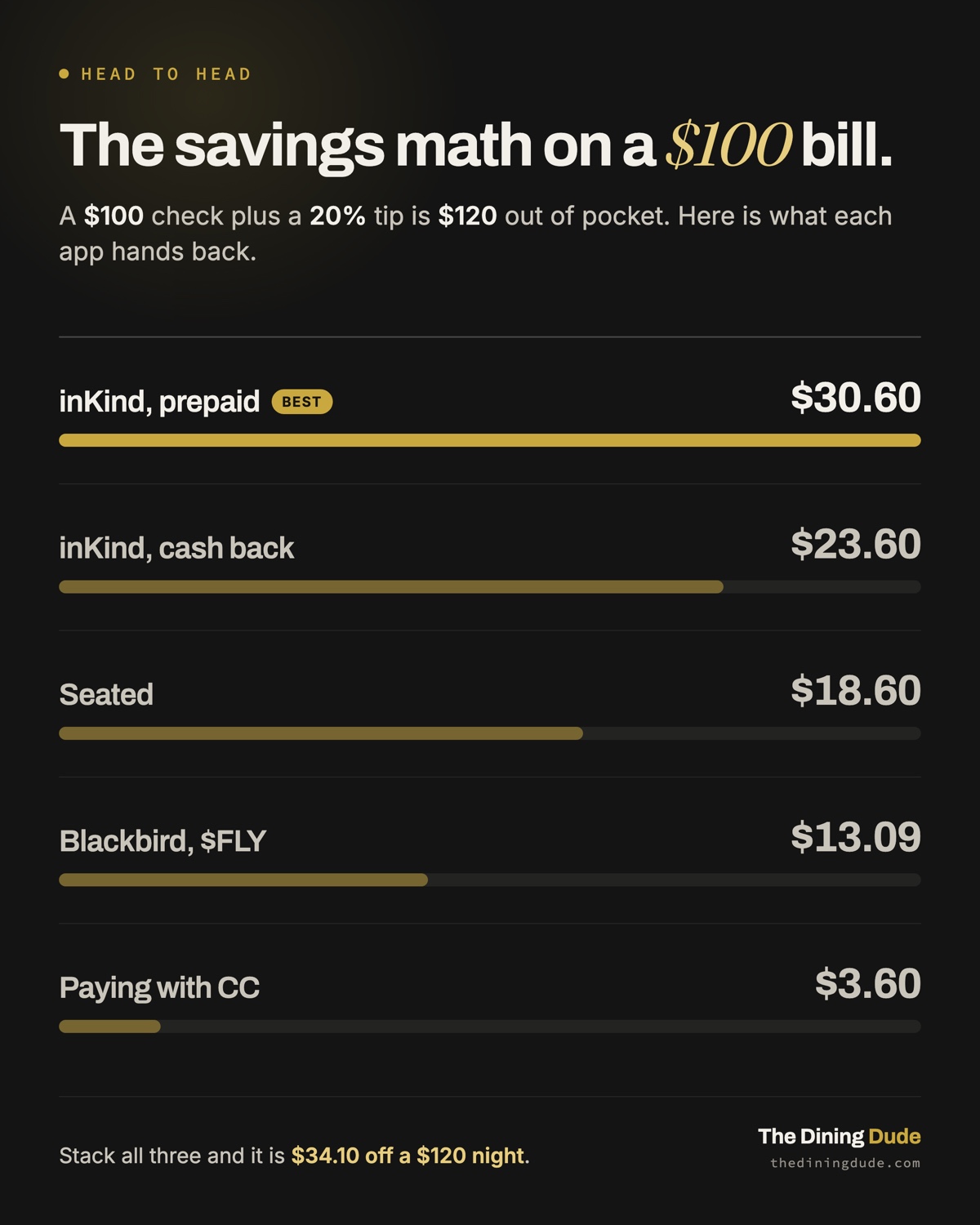
True Cost Total = $89.40 ($70 + $19.40), for a savings of $30.60 ($30 off of a $100 pre-tip bill).
Scenario 2: Not pre-buying credits, just getting 20% cash back.
Because inKind only gives you cash back on the pre-tip amount, this calculation is easy: 20% * $100 = $20
With 3% back on your CC for the whole amount = $3.60
True cost = $96.40
Scenario X: inKind often runs app-level or restaurant-specific deals, like $30 off $100. That obviously makes the math even better and you should use those***!
Blackbird
Scenario 1 (optimal): Preload FLY
I always buy FLY to get the 10% bonus. However, this means you don’t earn FLY on the purchase.
Blackbird allows you to pay the tip with FLY.
$120 in FLY costs you $109.09. 2% (because FLY = not dining) credit cards rewards on that = $2.18. So true cost = $106.91
Scenario 2: There is also the scenario where you don’t preload FLY, but if you care about money, I don’t know why you wouldn’t always preload with the 10% bonus, so I am not even going to cover that scenario.
Seated
Rewards rate vary by restaurant, but for the sake of this exercise, I am going to assume a 15% cash back rate (which seems ~average). Seated’s terms say that you earn on the pre-tip amount, but I have seen that vary depending on restaurant.
So on a $100 bill, you get $15. With a 3% CC reward, you also earn $3.60.
True cost = $101.40
BONUS - The ultimate rewards case (For Power Users and Deals Dorks only)
So you found the holy grail trifecta restaurant that is on all 3? Pay with inKind, check in with Seated + Blackbird.
Here is the power play: Activate your rewards on Seated, check-in on Blackbird, pay with inKind.
inKind savings = $30.60.
Seated savings = Surprise! Because on inKind you have to pay the tip on your credit card, you will earn the Seated rewards on this amount. 20*15% = $3
Blackbird checkin = $0.50
Is it worth it to have your nose stuck in three different apps instead of enjoying dinner?! Maybe not, but as a deals enthusiast, I recommend to just quickly whip out the apps when your dining partner is in the bathroom and then never touch your device for the rest of the meal!
Conclusion
On a $100 bill, with 20% tip ($120 total), here are the final costs/savings. Note: savings are compared to paying full amount with a debit card/cash, not to a CC.
| True cost | Savings | |
|---|---|---|
| Paying with CC | $116.40 | $3.60 |
| inKind | $89.40 | $30.60 |
| Blackbird | $106.91 | $13.09 |
| Seated | $101.40 | $18.60 |
Don’t even get me started if you have a bunch of fancy big business dinners…
The savings calculator
Put in any bill amount and see the true cost and savings for a credit card, inKind, Blackbird, and Seated side by side, plus what it adds up to over a year.
Open the calculator →TLDR guide for what app to use:
In terms of total savings:
- inKind saves you the most. Preload it whenever there is a +40% credits deal and use it to pay.
- Seated usually saves you the second most of the three apps, but is dependent on the restaurant cash back rate.
- Blackbird has the best coverage and a lot of hip restaurants. So when a spot is not on the other two, use it! But always preload and pay with $FLY to get the 10% bonus, which is better than all of the rewards tiers.
It is a no brainer that if a restaurant is on inKind, you should use that to pay. I am frequently surprised how often I see people enthusiastically using Blackbird at a restaurant that is on both. Don’t get me wrong, I love Blackbird for the restaurant coverage, but inKind is king when it comes to straight up savings!
The reason for this is the major difference in business models, which I want to break down in a future post.
Run the math yourself. $25 on inKind, 1,000 $FLY on Blackbird.
Sign up through my links and you get $25 to spend on inKind and 1,000 $FLY ($10 toward any meal) on Blackbird. Zero extra cost to you.
Get inKind → Get Blackbird →A few other notes on methodology
- You get a $0.50 bonus for checking in with Blackbird. But I didn’t include that in their breakdown, because you can still do this and then pay with any of the other apps.
- I treat “cash back” as savings/discounts by assuming this is as good as receiving cash (since you are very likely to eat out again).
Lastly, was any of this written with AI? NOOOOOOOOOOOO
*** Earlier I said that if inKind has a $30 off $100 deal, you should use those whenever possible. However, due to inKind’s change a few months ago that made it so that if you use one of those deals, you can’t also use your existing inKind Cash credits, there actually is a bill amount where it makes more sense to use your pre-purchased +40% credit amount (assuming you can always replenish that when the next bonus purchase period comes around).
Math: For total bill of X, your savings are equal when
X - X/1.4 = 30 + .2(X-30) —> X = $280
As in, when your bill is over $280, it is actually more beneficial to use your purchased credits. At this amount, you are saving $80 via both methods.
For the common $50 off $150,
X - X/1.4 = 50 + .2(X-50) —> X = $467